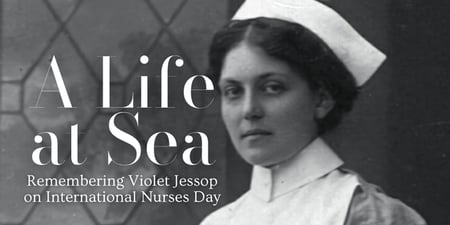

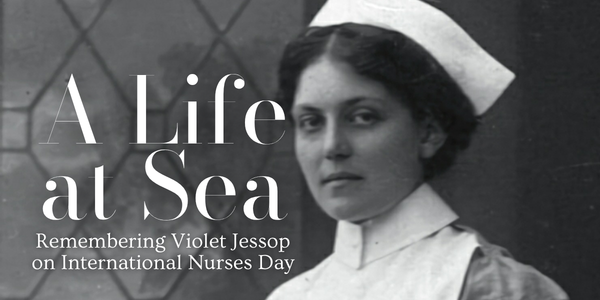
Violet Constance Jessop was born on October 1, 1887, in Argentina to William and Katherine Jessop, Irish emigrants. She was the eldest of six children and, from the very beginning of her life, a survivor.
As a young child, Violet contracted tuberculosis and was given only months to live by doctors. To their astonishment, she made a full recovery.
At the age of 16, Violet’s father died due to complications from surgery, leaving her mother as the sole caretaker and breadwinner for the family. They moved back to England, where Katherine Jessop began working as a stewardess for the Royal Mail Line. Violet attended a convent school and helped care for her youngest sister.
.png?width=236&height=295&name=Vertical%20Photos%20(25).png) When her mother later fell ill, Violet left school to support the family. She followed in her mother’s footsteps and applied to become a stewardess. At first, she was told she was too young and too attractive to work at sea. To improve her chances, she deliberately dressed more plainly and presented herself as more modest in appearance. This strategy worked, and at age 21, she secured her first stewardess position with the Royal Mail Line in 1908.
When her mother later fell ill, Violet left school to support the family. She followed in her mother’s footsteps and applied to become a stewardess. At first, she was told she was too young and too attractive to work at sea. To improve her chances, she deliberately dressed more plainly and presented herself as more modest in appearance. This strategy worked, and at age 21, she secured her first stewardess position with the Royal Mail Line in 1908.
After working there for about two years, Violet joined the White Star Line. Although she was hesitant about sailing through the cold North Atlantic, she eventually accepted a position aboard the Majestic before transferring over to the RMS Olympic.
On October 20, 1911, Violet was aboard the RMS Olympic when it departed Southampton and collided with the British warship HMS Hawke. Fortunately, there were no casualties, and the ship was able to return for repairs. Violet continued working aboard the Olympic until she transferred to its sister ship, the RMS Titanic. She was initially reluctant to join the Titanic, but a friend persuaded her, believing it would be a “wonderful experience.”
At age 24, Violet boarded the RMS Titanic for its maiden voyage on April 10, 1912. Just four days later, the ship struck an iceberg and began its descent into the North Atlantic.
In her memoir, Titanic Survivor, Violet described the events of that night and her role in helping calm passengers:
I was ordered up on deck. Calmly, passengers strolled about. I stood at the bulkhead with the other stewardesses, watching the women cling to their husbands before being put into the boats with their children. Some time after, a ship's officer ordered us into the boat (16) first to show some women it was safe. As the boat was being lowered the officer called: 'Here, Miss Jessop. Look after this baby.' And a bundle was dropped on to my lap.'
She remained in Lifeboat 16 for approximately eight hours before being rescued by the RMS Carpathia. Once aboard, the child she had been asked to care for was taken from her arms by a crying woman. Violet never learned the identity of the baby.
By this point, she had survived two major maritime incidents.
During World War I, known at the time as the Great War, Violet served as a nurse for the British Red Cross aboard the HMHS Britannic, the final Olympic-class liner..png?width=303&height=379&name=Vertical%20Photos%20(26).png)
On November 21, 1916, the HMHS Britannic struck a German naval mine in the Aegean Sea, causing catastrophic damage. The ship sank in just 55 minutes. Of the 1,066 people on board, 30 lost their lives.
Violet once again narrowly escaped death. In her memoir, she recalled:
I leapt into the water but was sucked under the ship's keel which struck my head. I escaped, but years later when I went to my doctor because of a lot of headaches, he discovered I had once sustained a fracture of the skull!
Within a span of just five years, Violet Jessop had survived all three major incidents involving the Olympic-class liners: Olympic, Titanic, and Britannic..png?width=629&height=330&name=Landscape%20Photos%20(15).png)
.png?width=629&height=330&name=Landscape%20Photos%20(16).png)
Despite these extraordinary experiences, she did not leave life at sea. In 1920, she returned to work with the White Star Line, later transferring to the Red Star Line, and eventually finishing her career where it began—with the Royal Mail Line. She retired in 1950.
Violet spent the remainder of her life in Suffolk, England. She did not shy away from sharing her remarkable experiences and was interviewed by Women’s Magazine in 1958 following the release of A Night to Remember.
Violet passed away on May 5, 1971, at St. Mary’s Hospital from bronchopneumonia and congestive heart failure. She was buried in Suffolk, England.
On International Nurses Day, we are proud to highlight the extraordinary story of Violet Jessop, a legacy we share with visitors each day at our museums. Her experiences stand as a testament to courage and perseverance. Copies of her memoir are available in our gift shops and online, and it remains one of the few published works written by a Titanic survivor.

Titanic Survivor Violet Jessop
$17.95Discover the memoirs of Violet Jessop, a stewardess aboard the Titanic, Olympic, and Britannic who survived accidents aboard all three ships. Complete and unabridged memoir; introduced, edited, and annotated by John Maxtone-Graham.
Related Topics